Showing posts with label YA novels. Show all posts

Sunday, January 24, 2010

Shelf Discovery Reading Challenge: Summer of My German Soldier by Bette Greene

Two down. Four to go.

I got more than expected from my re-reading of A Wrinkle in Time, but truth be told, I wasn't prepared for the emotional pummeling I received from Summer of My German Soldier. Like I wrote when I picked it for my challenge line-up, I have read a fair amount of books this past year that were in someway linked - thematically, plot, era, etc - to this book, but for as much as I've heard of it over the years, I've never had much interest in picking it up.

But Lizzie Skurnick piqued my interest with her look at the novel. Also, I'm always interested in older books, especially YA books, and how they deal with their chosen historical period. Written in 1973, Summer of My German Soldier covers a summer amidst WWII, and it's interesting to see what further distance from a time period does to a particular era's perspective.

So how does Summer of My German Soldier hold up?

Wonderfully, and somewhat alarmingly, well. Wonderful, because Greene's Patty Bergen remains a fresh, interesting, lovable (even if frustrating) protagonist. The unlikely alliance between Jewish Patty and Frederick Anton Reiker, a Nazi POW imprisoned near Patty's town, stands for more than a simple message of tolerance. Or, rather, it complicates the issue of tolerance, in that it becomes not a question of "should have shown such tolerance in this situation" but "What should be intolerable?"

If you break it down, there's every reason that Patty would find herself allied with Anton. He shows her interest and humor and genuine appreciation. He is impressed with her intellectual acumen and not put off by rambling, hyperbolic conversation. She sympathizes with his backstory, even envies his close relationship with his family. His family seemed to value intellect and despise the Nazi regime, yet they are weak to its control. The Bergens, on the other hand, seem to value purely money and social status, and they are very much in-line with the problems rooted deep into their town's society, including both institutional and outward racism, sexism, and a dedication to purely surface understanding.

While Patty can forgive Anton's participation as a Nazi soldier for being a smart boy from a good family in the wrong circumstances, she cannot come to terms with the disappointment that is her parents. Her father's simmering rage covered by sneering indifference. Her mother's near constant verbal abuse and put-downs. It's no wonder that Patty lies as much as she does: She'd do almost anything to win their approval, and approval from any of the town's adults, and that includes telling self-inflating falsehoods.

With Anton, Patty doesn't have to lie or fear reprimands for being herself. For a moment after admitting to Anton that she is Jewish, she is convinced he is going to go cold with hatred, but he just laughs in disbelief. A Jewish-American girl helping a German POW. He marvels at the situation.

Greene could be faulted for not giving Patty a more conflicted conscience or by not having Patty challenge Anton's innocence - I mean, yes, he had to go, so despite his family's good standing and intellectual nature, he is still a boy making a choice to go along with the regime in power - but far enough into the novel is the realization that Anton will never be an absolute real person with real faults and difficult things to swallow. Patty is a twelve year old in desperate need of someone who can find the good in her. Anton, in doing so, allows Patty to find nothing but good in him. He is like the cheap glass "diamond" broach that he uses to bribe a guard to escape prison. His outward self is something unseemly and undesirable, but he becomes so much more valuable in his active, useful form. The Anton that Patty feeds and shelters and protects from harm is a more realized form of the Anton that is led off a train to a prison for being a German soldier.

Patty never gets to the next level of Anton, the one that exists in tandem and outside these circumstances, the one that has to account for all that he has done and not simply for the good, respectable parts. But his friendship is enough for her, and long after her actions are discovered, and she is sent to a reformatory school, she is reminded to hold onto the memories of his feelings for her. She found someone to value her for the very traits that her parents either dismissed or became enraged about, and that surpassed any preconceptions about him, that surpassed blind hatred and disgust.

Sunday, December 6, 2009

It's hard to turn the page when your fingers are frozen...

We have held off turning our heat on, fearing overwhelming gas bills in addition to the large electricity tab running every month. But the cold has proved itself a constant, and our efforts to stave off the chill in our apartment have gone largely unrewarded. This morning, the space heater, which I have taken to snuggling like a romantic partner, broke down.

So it's me, a heating pad, a sea of blankets, and an effort to read without exposing my fingers. Maybe the Snuggie people have it right - I am having trouble moving my arms without losing some of the blanket's protection. Still, I will not pay twenty bucks to wear a robe backwards, even if it means reading underneath the blanket... and missing out on a cool and useful complimentary booklight.

This week has been a fairly good one for reading. I finished Kazuo Ishiguro's Never Let Me Go last weekend, followed it up with the surprising The Last Summer of the Death Warriors, Francisco Stork's follow-up to this year's acclaimed Marcelo in the Real World. I'm now a bit more than halfway through Michael Adams' funny and brisk year-long quest to find the worst movie ever made, Showgirls, Teen Wolves, and Astro Zombies. Adams' doesn't have the innate charm of other year chroniclers, notably AJ Jacobs, and the heart of the text doesn't completely make-up for the format's limitations, but still, it's an easygoing, even compelling study of what makes a "bad" film and what makes a truly terrible film, told with enthusiasm by the likable Adams.

If I don't freeze to death, I'll finish that one today. Then it's back on kids' upcoming releases. There's a new one coming out by Esperanza Rising author Pam Munoz Ryan that I've got to check out, and several from Random House that look great. I also might give Scott Westerfield's Leviathan a shot. I've been in a bit of a steampunk mood, ever since discovering this fantastic Etsy shop, but because I'd have to finish The Court of the Air to read its just released follow-up, maybe I'll stick with the new Westerfield.

And of course, there's always book #2 in the Shelf Discovery Reading Challenge. Oh, and I have to read Diary of a Wimpy Kid before Mother-Daughter Book Club on Thursday.

So much to read, so little time, so little heat. Let's hope that gets fixed soon.

Monday, November 2, 2009

Shelf Discovery Challenge!

You can't throw a stone in blogville without hitting a reading challenge, but I finally stumbled upon one that I think I can manage. Courtesy Booking Mama, the "Shelf Discovery Challenge" asks its readers to choose six books featured in the the book Shelf Discovery by Lizzie Skurnick, read them in the next six months, a report on each one.

About Shelf Discovery:
Launched from her regular feature column Fines Lines for Jezebel.com, this spastically composed, frequently hilarious omnibus of meditations on favorite YA novels dwells mostly among the old-school titles from the late '60s to the early '80s much beloved by now grown-up ladies. This was the era, notes the bibliomaniacal Skurnick in her brief introduction, when books for young girls moved from being wholesome and entertaining (e.g., The Secret Garden and the Nancy Drew series) to dealing with real-life, painful issues affecting adolescence as depicted by Beverly Cleary, Lois Duncan, Judy Blume, Madeleine L'Engle and Norma Klein. Skurnick groups her eruptive essays around themes, for example, books that feature a particularly memorable, fun or challenging narrator (e.g., Louise Fitzhugh's Harriet the Spy); girls on the verge, such as Blume's Are You There, God? It's Me, Margaret or danger girls such as Duncan's Daughters of Eve; novels that deal with dying protagonists and other tragedies like child abuse (Willo Davis Roberts's Don't Hurt Laurie!); and, unavoidably, heroines gifted with a paranormal penchant, among other categories. Skurnick is particularly effective at spotlighting an undervalued classic (e.g., Joan Aiken's The Wolves of Willoughby Chase) and offers titles featuring troubled boys as well. Her suggestions will prove superhelpful (not to mention wildly entertaining) for educators, librarians and parents.


Maureen, the lovely marketing director at my bookstore, was nice enough to hand me a galley copy of this book last Spring, and I have periodically read through bits and pieces of it. It's that perfect kind of browsing book - you can pick it up, read a few entries, put it down, and repeat.

The real joy of Shelf Discovery is discovering and re-discovering books that, while ultimately intended for young readers, continue to leave lasting impressions on women who later went to create lasting works of writing themselves. Nothing quite like authors gushing about books to pique my interest.

As an excuse to read some vintage YA literature, this challenge is perfect for me, but it's also going to be fun to re-explore books that I read at the proper demographic, ones that I may remember fondly or unhappily or hardly at all.

The challenge asks you to read six of the books featured in the text in six months, but I'm thinking about attempting to double that number. We'll see how I fare. For now, here are my six books:

- A Wrinkle in Time by Madeline L'Engle
Why: This was the book that my mom kept insisting that I try as a kid, but I never bothered to follow her advice... until I randomly picked this up the summer before college. Having read When You Reach Me this past summer, I've been wanting to re-read this classic that I only embraced late into my teens.

-Summer of My German Soldier by Bette Green
Why: This past year, I've read two books that have been cited as inspired by this 1973 work by Bette Green, concerning a Jewish girl who harbors a Nazi escapee from a POW labor camp during the close of World War II. But I've never read this one, so now's the time.

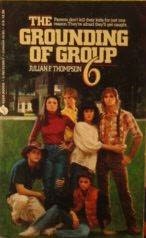
-The Grounding of Group 6 Julian F. Thompson
Why: I have never heard of this book, but it's from the tail end of the first YA wave, and its premise - six teenagers are sent to an academy where there parents have paid for them to be "poisoned and thrown into deep crevasses" - sounds promising enough. Skurnick, writing about this book, calls into focus the prevalence of bad parents in this wave of young adult fiction, something that, while not completely absent from today's YA, has long since been the trend. "So, as ascends Gilmore Girls, so dies a golden YA trope - the parent who deserves to die."


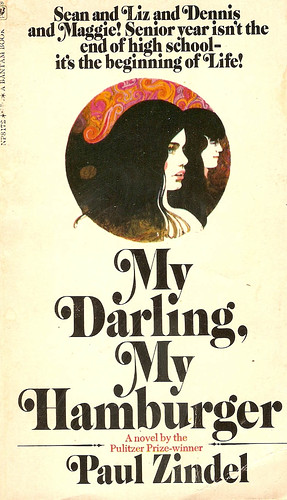
-My Darling, My Hamburger by Paul Zindel
Why: Because 1)It's Paul Zindel, and I still consider The Pigman one of my all-time favorites, 2) I've known of this book for a long time but never even knew what it was about, and 3)Um... the title. Yeah, I'm that simple.


-The Witch of Blackbird Pond by Elizabeth George Spears
Why: One of those books that seems fundamental to a YA reading history, and yet, I haven't read it. I had many, many friends who read it, so I suppose I never felt it necessary to read it too, a mindset I'm all to liable to fall into still.

-Blubber by Judy Blume
Why: Judy Blume is the Queen of YA. The first wave would never have broken quite as hard without her books. As a teenager, I didn't read most of the Blume classics. I read Summer Sisters, her comeback, for adults title while I was in high school, but I haven't read any Blume since then. This one's a short fix, so I should be able to get to it in an afternoon. Mean girl politics, especially those at a pre-teen age, are nothing like what you commonly see on television now.

Okay... fingers crossed that I stay with this one. I'll be making periodic updates to my progress. If you're interested in joining the challenge, check out Booking Mama for more information.

Wednesday, September 16, 2009

Review: Impossible by Nancy Werlin

It is suitable that I fell in love with Impossible by Nancy Werlin - after all, the book is about the redemptive power of true love against extraordinary odds, about how believing in love is the ultimate leap of faith, and how that faith can bring remarkable strength for even unfathomable tasks. But the novel doesn't beg or plead for your love - it doesn't need to. Rather, like its main characters, it enraptures the reader, capturing, enchanting the reader. Picking up this book was like sustaining a hypnotic state that I didn't want to shake.

Lucy Scarborough grows up in a loving home amongst a supportive foster family and enduring friendships, but she is haunted by the recurring presence of her mother, Miranda, a frequently disappearing vagrant whose reappearances are marked by obscure, hostile remarks, inexplicable actions, and a version of the folk song "Scarborough Faire." For most of Lucy's life, Miranda's appearances are simply a disruption - a blight on an otherwise idyllic upbringing with two open-minded, understanding foster parents.

At seventeen, however, Lucy learns of the true background of Miranda's illness - a family curse, placed by the Elvin Knight after being spurned by a human woman, Fenella. The Elvin Knight arranges for each daughter of Scarborough to be impregnated by eighteen, then burdens themwith the three impossible tasks from the song "Scarborough Faire" - if they can achieve each impossible task by the time the baby is born, the curse will be broken. Otherwise, they will go insane and the curse will repeat its pattern on the next generation.

As Lucy begins to understand the curse, its implications on her, her mother, and her family history, she sets to accomplishing the three impossible tasks before the birth of her own daughter. Unlike her mother, however, Lucy has the love and helpful support of her parents and longtime friend, Zach Greenfield - but will it be enough to save her sanity and that of her unborn daughter's?

To tell more than that is to give away significant portions of the text, which would be a shame because Werlin builds an intensity so subtle, 100 pages passed without notice, then another 100 pages. The use of "Scarborough Faire" as setup is an ingenious move - the song, often thought of as beautiful and loving, can also be read in very sinister terms, with the protagonist asking the impossible of a possible "true love," insisting that if these tasks are not completed, then she is not a true love of his - but without an excellent execution, Werlin's device would have come off as a novelty.

Werlin's a better writer than that. The touch of magic inhabits almost every character and plot action, but she never overdoes it. She lets the vibe carry through the story, but doesn't pushes by filling her plot with an overabundance of magical characters, strange happenings, or fantastical occurrence. The magic comes in bits and pieces - a character's devotion to another, an implicit understanding, a family bond, a lucky coincidence, an odd presence - and the characters realistically respond to out of the ordinary things.

Werlin crafts an excellent protagonist in Lucy. She's smart and strong, but fallible, and by midway through, the reader's affection for her is on par with that of the supporting characters of the novel. There always seems to be a purpose to her choices, even when her decisions are confusing or counter-productive, and it is to Werlin's credit as an author that while the love story set up for Lucy is pushed along rather quickly, it matches the tone of inevitability coursing through the book.

Good versus evil looms large, but inevitability is also a core concept - how inevitable is Lucy's fate? In the long line of Scarborough daughters, not one has managed to break the curse on the family. In her journal, eighteen year-old Miranda confesses that she could not even accomplish the easiest of the three tasks. She fears for her sanity each day closer to the birth of her daughter, the inevitable turn that will happen after the baby is born, after each Scarborough baby was born.

But Miranda's situation is unlike the others before her, and also that of Lucy's. While the others suffered in predictable loneliness and despair, Lucy has the abounding resolution of her family around her. She is supported by something much stronger than the crushing compounding doom of the looming family curse. What has been inevitable may not be once the impossible is achieved.

This is a YA novel for any age, a fairy tale for all audiences, a beautiful and beautifully written story.

Wednesday, April 1, 2009

The Forest of Hands and Teeth or Why I Hate Selling Young Adult Novels in a Post-Twilight World

No doubt, the publishing industry is attempting to rebound from the fiscal crisis by banking on whatever is the most plausible follow-up sensation to the epic, sales-juggernaut Twilight series. Booksellers, librarians, pub reps, avid readers, anyone with a remote interest in the topic is laying their bet on what is going to be the next big series draw. Some are staying with vampires. Some are leaning heavily on werewolves (it seems so long ago since Blood and Chocolate, does it not?), others are saying ghosts (very probable), but some... some are laying their bets on zombies.

Of new YA novels, March's buzz book was The Forest of Hands and Teeth by Carrie Ryan, mostly because the smart folks at Random House had the savvy to align it with Twilight without making direct comparisons, and because a lot was made of the supposed violence and dark tone of the novel. Well, and I'll admit this right now, I have not read Twilight (although I did read The Host, which proved to be surprisingly sturdy, if problematic...), but I can guarantee that if Twilight held the same poor writing, bad pacing, and gaping plot holes that this novel suffered so severely from, there's no way it would have the near religious following it does now.


The basic premise: Mary has grown up in a cloistered, protected world, defined by the Sisters who run the town, and the fence that separates the civilized from the hungry, savage "Unconsecrated," who, generations ago, rose in population to such a degree that, outside of the village, mankind no longer exists... or does it? Growing up, Mary's mother passed along family stories of life before the Unconsecrated, of cities and human populations and oceans. As a result, the young woman is plagued by a restless curiosity that inevitably leads to trouble.

When the fences are breached, Mary and a small crew of survivors must figure out how to survive while traveling a fenced path that may or may not lead to their salvation. Meanwhile, Mary is struggling with her feelings for Travis, a fellow villager, but cannot freely express her love due to his betrothal to her best friend, Cass, and Mary's own betrothal to Travis's brother Harry. Also along for the death trek is Mary's brother Jed and Jed's pregnant wife, Beth.

The first half of the novel is semi-promising, with its venture into the convent of the Sisterhood that runs the village and the sudden, ominous appearance of a stranger, whose appearance isn't nearly as troubling as her then sudden disappearance. But very little of the Sisterhood's conspiracy is fleshed out, and Mary's minor discoveries, made in the hidden, underground chambers of the Cathedral are surprisingly anti-climatic.

By the time the village is seized by the undead, the story is falling apart. Mary is a difficult protagonist to become attached to as a reader. Under a more capable hand, her contradictions would be worthwhile complexities, and watching her slowly unravel would be a breakthrough for the character as well as the reader. Instead, she is poorly drawn, and instead of coming off sympathetically rebellious, she comes off unreasonably stubborn, difficult, and self-serving. Ryan doesn't attempt to help the reader understand Mary's intrinsic attraction for Travis. The feelings exist, they continue to exist, but the few meaningful details the reader is given don't add up to a romance of impact.

Ryan is a mediocre writer. Not by YA lit standards, because I don't believe that there is necessarily a lower standard, but by genre standards. It is possible to write a thrilling horror novel without losing narrative nuance. Sarah Langan is the name I throw around the most, because I found The Missing just absolutely enthralling. Ryan can't hold the story together. Her supporting characters border on caricature, and attempts to add dimension only muddle the depiction even more.

The ending is a mess. The whole ordeal is reminiscent of the movie The Village, but more abruptly startling in its absurdity. And, as a reader, I didn't buy any of it. It's fine to ask your readers to take certain leaps of faith with you, to suspend disbelief in matters of the plausible. It is not the same thing to write something filled with holes that renders the outcome nearly implausible.

And if I had to read of a character smelling like sunshine one more time...

Yet, with all my complaints, even initially, with the text, I finished the book. There's something weirdly intoxicating about the book that allowed me to continue reading, despite my growing disinterest. I described this feeling to a friend of mine, and she responded with, "I felt the same way during Eclipse [the third Twilight book]. And I had to read the fourth book too."

If there is any mercy in the publishing world, Carrie Ryan will not write another installment. I don't know if I'll be able to stand another book... or resist it.

The trailer for the book is actually more entertaining than the entirety of the novel. Maybe because it uses imagery and words from the first half...